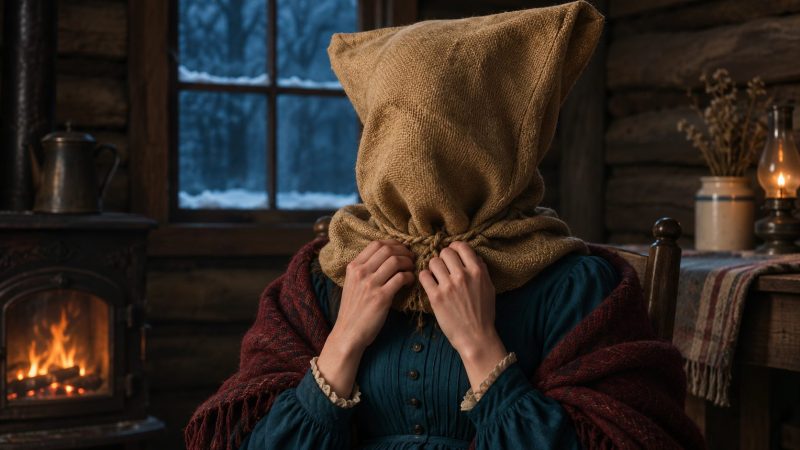
“The sack fell—and he stopped breathing.” 😨
The winter cold cut across every face in the square, yet no one in the crowd seemed eager to leave.
All eyes were fixed on a wooden wagon.
A young woman stood on top of it in a dark blue dress. Her hands were tied in front of her, and a rough burlap sack covered her entire head, with only two small holes cut for her eyes.
She was trembling.
No one knew whether it was from the cold or fear.
Abel Red stood beside her, waving a stack of papers in one hand.
“This woman carries a heavy debt,” he announced. “Whoever pays thirty dollars may take responsibility for her. But don’t say I didn’t warn you. She brings trouble.”
Laughter broke out among the crowd.
Someone shouted:
“At least show us her face! She might not even be worth thirty dollars!”
The laughter grew louder.
The woman lowered her head.
Her bound fingers slowly tightened together.
That was when Silas entered the square.
He had come to buy salt, lamp oil, and a few tools for winter. When he saw the crowd, he initially had no intention of getting involved.
Then he heard Red’s voice.
Silas knew that man.
Red always smiled while contracts were being signed, yet over the years many families had lost their homes and land shortly after seeing that smile.
“If nobody pays before sunset,” Red continued, “I’ll leave her right here. The frost can decide what happens next.”
Silas stopped walking.
He looked at the woman.
She wasn’t begging anyone for help.
She didn’t speak at all.
Only her eyes, visible through the holes in the sack, moved slowly from the faces around her to the frozen ground.
Silas walked to the table and placed thirty dollars on it.
The laughter disappeared.
Red smiled.
“Finally, someone with some sense.”
“Take the money,” Silas said. “But she isn’t yours to sell to me.”
Red’s smile weakened.
“Sign the paper.”
He pushed a document toward him.
Silas read it carefully, then pushed it back.
“This says I own her.”
“What else did you expect?”
Silas took a blank sheet of paper and wrote that the thirty dollars were being paid only to settle the woman’s alleged debt. He signed it and demanded that Red sign as well.
By then, no one in the crowd was laughing.
Red reluctantly added his signature.
Silas approached the woman.
“You can come down.”
He offered his hand but did not touch her.
For several seconds, she remained still.
Then she climbed down by herself.
They barely spoke on the journey away from the settlement.
Only when the noise behind them had disappeared did Silas finally ask:
“Can you take that sack off?”
The woman immediately stopped walking.
“Not here,” she whispered.
Her voice sounded muffled and unsteady.
Silas nodded.
“All right. When you’re ready.”
For the first time, she looked at him for more than a second.
At the cabin, Silas lit a fire, placed a bowl of hot soup on the table, and deliberately left the door unlocked.
“You’re free to leave,” he told her. “If you want to go, I won’t stop you. If you want to stay until the weather clears, you can stay.”
She sat near the fire.
The sack remained over her head.
Several minutes passed before she lifted her bound hands.
“Can you untie me?”
Silas approached slowly.
“If you tell me to stop, I stop.”
He carefully loosened the rope.
The woman rubbed her reddened wrists.
Then she reached toward the knot holding the sack around her neck.
Her fingers trembled.
Silas turned away so she would not feel watched.
Behind him came the soft rustle of rough fabric.
“You can look now.”
Silas turned around.
The sack lay on the floor.
He froze. 😨
Near the woman’s left cheek was a small crescent-shaped birthmark.
Silas stared at it.
He had last seen that mark fifteen years earlier.
On the face of his little sister.
“Nora…?”
Her eyes filled with tears.
Without speaking, she reached beneath her dress and pulled out a thin silver chain.
A broken half of a medallion hung from it.
Silas slowly reached beneath his shirt and pulled out the other half.
His hand began to shake.
When the two pieces came together, they formed a tiny engraving of two fir trees with a small house between them.
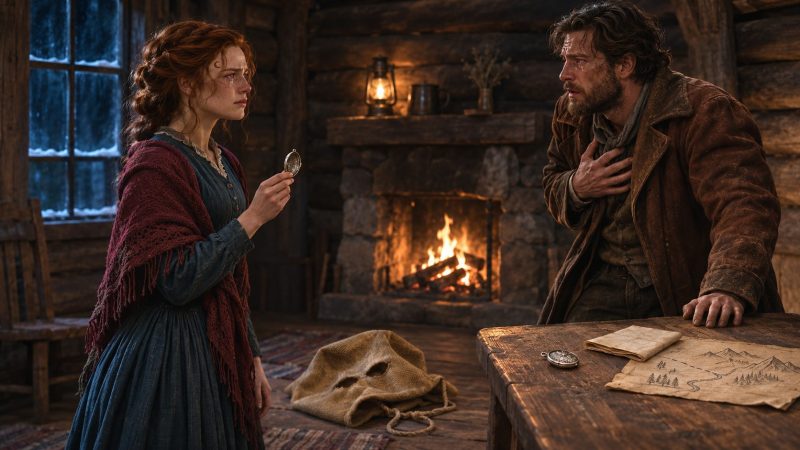
Nora could no longer hold back her tears.
“I thought you were dead.”
Silas lowered himself into a chair.
Fifteen years earlier, their family home had caught fire in the middle of the night.
Silas had run for help.
By the time he returned, the house had been reduced to ashes.
Everyone told him that his mother and little sister had still been inside.
No bodies were ever recovered.
But people kept repeating that no one could possibly have survived.
For years, Silas blamed himself for leaving the house that night.
“Mother got me out through a back window,” Nora said. “She was already badly burned. A few days later, she left me with a healer. She died several months afterward.”
Silas’ eyes filled with tears.
He did not move toward her.
He waited.
Nora was the one who finally stepped forward.
When they embraced, neither of them spoke.
Fifteen years of grief could not fit into words. ❤️🩹
But Nora’s return was about more than finding her brother.
She opened her bag and removed an old notebook, a folded land map, and several documents.
“Red has been looking for me because of these.”
One document showed that before their father died, he had legally registered the family spring and the surrounding land in the family’s name.
That land had since become extremely valuable.
Red wanted to transfer it to a mining company using falsified boundary records.
The notebook contained years of payments connected to altered surveys, forged documents, and people who had been paid to remain silent.
“My father discovered what Red was doing before the fire,” Nora said quietly. “And Red was near our house that night.”
Silas’ jaw tightened.
“You think he started the fire?”
“I don’t know if he lit it himself,” Nora replied. “But I know he used the fire to make sure no one came back for that land.”
Silas stared at the documents.
Then at his sister.
For fifteen years, he had believed the fire had destroyed everything.
Now he wondered whether it had been meant to erase them.
The next morning, they returned to the square.
Nora carried the burlap sack with her.
People gathered again when she climbed onto the same wooden wagon.
This time, no one forced her up there.
She stood on it by choice.
Red pushed through the crowd when he saw her.
His face immediately changed.
Nora raised the sack so everyone could see it.
“Yesterday, this was put over my head so none of you would know who I was.”
The crowd fell silent.
Then she dropped it at Red’s feet.
“Today, I want everyone to see me.” 😨
Red’s eyes moved toward the road.
Nora held up the documents.
Silas unfolded their father’s old land map.
A postal worker stepped forward and recognized Red’s handwriting in the notebook.
Then an elderly blacksmith spoke.
He remembered seeing two barrels of lamp oil on Red’s wagon the day before the family home burned.
Whispers spread through the crowd.
Red began backing away.
The sheriff stepped into his path.
“Where are you going?”
“This proves nothing,” Red snapped.
“Maybe not yet,” the sheriff replied. “But it proves enough to start asking questions.”
Red was not convicted that day.
There had been too many years between the fire and Nora’s return for anyone to pretend the truth could be settled in a single afternoon.
But the land sale was immediately suspended.
The notebook was taken as evidence.
The property records were ordered to be examined.
And for the first time in fifteen years, people began questioning the story they had all been told.
Nora stepped down from the wagon.
Silas waited for her below.
“You helped me before you knew who I was,” she said.
Silas looked at his sister.
“If I had never discovered your name, I still wouldn’t have left you up there.”
Nora smiled through her tears. 🥺
That evening, she returned with him.
Not as a “bride” someone had purchased.
Not as a woman who owed a debt.
But as Nora—a woman who had taken back her name, her choice, her land, and her voice.
The rough burlap sack remained behind in the square, half-covered by fresh snow.
It no longer hid anyone.
Because covering a person’s face can be easy.
Keeping the truth hidden forever is not. ❤️🩹