I hid above the chandelier—and heard my daughter expose the lie. 😨
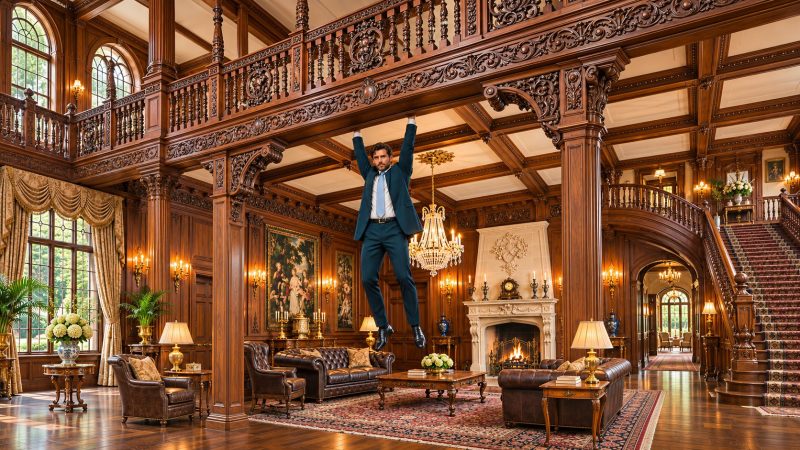
One hand gripped the carved wooden beam above me.
The other tried to keep me balanced.
A massive crystal chandelier hung beneath my shoes.
Far below, my seven-year-old daughter Clara sat in the grand living room with my new wife, Helena.
I had not climbed up there by accident.
For three weeks, anonymous letters had been appearing.
“Helena is turning Clara against you.”
“She is teaching your daughter false memories.”
“If you don’t stop her, Clara will soon be afraid of you.”
At first, I threw the letters away.
Then I noticed Clara spending more time alone with Helena.
And instead of asking either of them what was happening, I made the worst choice possible.
I started watching them in secret.
Clara had a notebook open on the table.
She had drawn our house—the staircase, the fireplace, the library.
But behind the fireplace was a narrow passage I had never seen.
Helena did not touch the drawing.
“Can you tell me what this is?” she asked gently.
Clara pointed to a tiny star she had drawn beside the fireplace.
“Mommy told me not to forget this.”
My throat tightened.
She was talking about Isabel, her mother.
My late wife had died two years earlier from a sudden heart condition.
It happened so fast that my memories of that night still came in fragments—the ambulance lights, Clara crying, the empty hallway afterward.
Months earlier, Clara had mentioned a “blue door” and “a room inside the wall.”
I had told her she must have imagined it.
Now I regretted those words.
“What is at the end of the passage?” Helena asked.
Clara shrugged.
“I don’t remember.”
Then she thought for a moment.
“Mommy said if grown-ups ever tell me I remember it wrong, I should draw it before I forget.”
My fingers went cold around the beam.
Helena never told Clara that I had been wrong.
She simply asked:
“Would you like us to check together?”
Clara nodded.
Then Helena suddenly looked upward.
Straight at me.
I froze.
She had seen me.
But she said nothing.
A few minutes later, they left the room.
I climbed down, my knees shaking.
Helena was waiting for me in the library.
“You were spying on us?”
I could have lied.
I didn’t.
“Yes.”
Hurt filled her face more than anger.
I showed her the letters.
She read each one carefully.
“And you believed them?”
“I started doubting you.”
“You could have asked me.”
“I know.”
I did not defend myself.
That seemed to surprise her.
Helena sat down and remained silent for several seconds.
Then she reached into her pocket and pulled out a small brass key tied to a faded blue thread. 🔑
“Isabel gave me this.”
I stared at her.
“You knew Isabel?”
“I worked with her in the family foundation archives.”
Helena explained that, months before Isabel died, she had started reviewing old financial records.
Money intended for housing projects had been disappearing from the foundation.
Isabel believed someone close to the family had been hiding the transfers.
“She told me to keep this key until Clara remembered the star.”
“Why didn’t you tell me?”
Helena looked directly at me.
“Because Isabel wasn’t sure who she could trust.”
The answer hurt.
But for the first time, I decided not to defend myself against an uncomfortable truth.
The next morning, we brought in an old-building specialist.
He confirmed there was an empty space behind the fireplace.
With Clara nearby, we carefully removed the wooden panel.
A narrow hidden compartment appeared behind it.
Inside were three wooden boxes.
One had a bird carved into its lid.
Another had a tree.
The third looked completely plain.
Until Clara leaned closer.
“Daddy…”
She touched one corner.
Under years of dust was a tiny blue star carved into the wood.
The same star she had drawn. ⭐
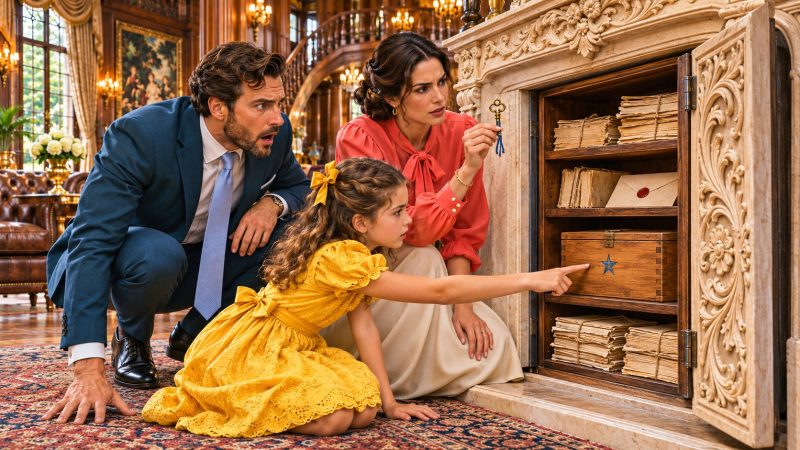
Helena’s key opened the plain box.
Inside were foundation reports, copies of bank transfers, and pages covered in Isabel’s handwriting. 📄
Money had been transferred for years from the foundation into a company connected to my father Arthur’s closest adviser.
But the worst discovery was underneath those documents.
We found a draft of one of the anonymous letters.
The same phrases.
The same accusations against Helena.
And beneath them, a note in my father’s handwriting:
“If Sebastian begins trusting Helena, she may help him find the room.”
I did not call my father immediately.
Instead, I gave everything to an independent attorney.
Two days later, Arthur came to the house.
The moment he saw the box on the table, his expression changed.
“Why did you send the letters?”
He did not deny it.
“I wanted you to stop.”
“Stop what?”
“Digging into the past.”
The truth finally came out.
Arthur had not started stealing from the foundation.
His adviser had.
But years earlier, Arthur discovered the missing money and chose to hide it because he feared the scandal would destroy the family name.
Isabel later found the records.
When she died from natural causes, Arthur believed the secret had died with her.
Until Helena returned to our lives.
“I was trying to protect the family,” he said.
“You were protecting the secret.”
He said nothing.
That silence was enough.
The attorney then opened the second box.
There were no financial documents inside.
There was a small voice recorder.
My hands shook when I pressed play.
Isabel’s voice filled the room.
“Sebastian, if you’re hearing this, then Clara remembered.”
Clara squeezed my hand. 💔
“Please don’t teach her to doubt her own memory just because the truth makes adults uncomfortable.”
I closed my eyes.
Then Isabel continued.
“And if Helena is beside you, judge her by what she does—not by what someone else tells you to believe.”
Helena silently began to cry.
Within weeks, the foundation records were turned over to investigators.
Arthur cooperated and stepped away from his position.
That did not magically restore my trust in him.
My trust in Helena did not instantly repair itself either.
I had hurt her by believing anonymous letters before asking her one honest question.
So we stopped pretending everything could be fixed overnight.
We started talking.
Really talking.
The hidden room was eventually restored and turned into a family archive.
No more sealed walls.
No more documents buried behind wood.
No more telling Clara that something she remembered must have been imaginary simply because adults could not explain it.
One evening, she brought me another drawing.
This time, there was no secret passage behind the walls.
Instead, she had drawn an open door.
Three people stood beside it.
“What house is this?” I asked.
Clara smiled.
“The house where, if we don’t know something, we ask each other.” ❤️
I looked up toward the old wooden beam where I had once hidden to spy on my own family.
It was still there.
But I would never use it that way again.
Because a home does not become safe when its secrets are hidden well.
It becomes safe when no one inside it has to hide. ❤️🩹