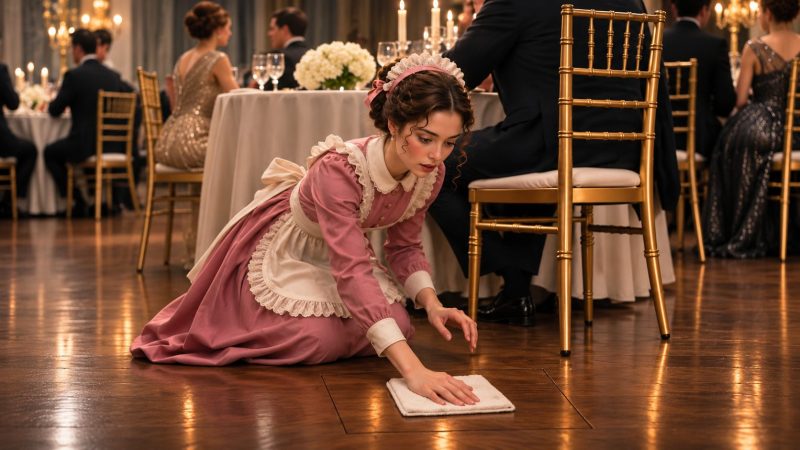
The maid moved one cleaning cloth—and the housekeeper whispered, “Don’t touch that.”
Amara worked as a maid in the Vale family’s mansion.
That evening, the house was filled with guests attending an elegant charity dinner.
Soft music played beneath the conversations.
Waiters moved between candlelit tables while crystal glasses reflected the chandeliers above them.
Amara was kneeling beside a gold chair, cleaning wine that had spilled across the polished wooden floor.
A small white cleaning cloth covered a square section of the floor, barely twenty centimeters wide.
She wiped the wood once.
Then she pulled the cloth aside.
Her hand stopped.
In the center of the small wooden square was a gold ring.
It was not jewelry.
The ring was fixed directly into a circular metal opening in the floor.
Around it, Amara could suddenly see four perfectly straight seams forming a square.
She leaned closer.
“There’s a ring here,” she called out.
“But I think it’s part of the floor.”
A nearby waiter stopped.
Several guests turned toward her.
Then Martha, the elderly housekeeper, hurried over.
The moment she saw the ring, the color drained from her face.
“Don’t touch that,” she whispered.
Amara looked up at her.
“Why?”
Martha did not answer.
Then a faint sound came from beneath the floor.
The nearby guests fell silent.
Amara froze.
At first, it sounded like an old pipe.
Then it came again.
A weak sound.
Almost impossible to understand.
A woman at the nearest table covered her mouth.
Someone else immediately raised a phone and began recording.
Amara slowly moved backward.
“Did everyone hear that?”
One of the guests, Cole, stepped forward.
He was a structural engineer.
He crouched beside the small square and examined it carefully.
“This ring is a release handle,” he said.
“But this little section isn’t large enough to be an entrance.”
He rotated the ring.
A small wooden panel lifted.
Beneath it was an old mechanical latch.
Cole followed the seams across the floor with his fingers.
“This releases a much larger panel.”
Martha stared at him.
“No one has opened that in years.”
Cole looked at her.
“You knew this was here?”
“I knew there used to be an underground storage level.”
Her voice trembled.
“They told me it had been sealed permanently.”
Another sound came from below.
This time, everyone heard it clearly.
“Help me.”
The room erupted in frightened whispers.
Amara immediately moved toward the panel.
“We need to open it.”
Cole stopped her.
“Not alone.”
He showed them where the larger section ended.
Two guests, a waiter, Amara, and finally Martha placed their hands along the edges.
Together, they pulled.
For several seconds, nothing happened.
Then the heavy wooden panel shifted.
Cold air rushed upward.
A narrow staircase appeared beneath the banquet hall.
At the bottom was a metal door.
A weak yellow light glowed behind it.
Someone screamed.
Others stepped closer, phones still recording.
Cole turned on his phone flashlight.
“Call emergency services.”
Several guests already had.
Amara leaned toward the opening.
“Can you hear us?”
Something moved below.
Then a man slowly appeared behind the metal door.
He was painfully thin.
His beard was overgrown.
His clothes hung loosely from his body.
His face looked exhausted.
But he was alive.
The man raised his head.
“Please don’t close it again.”
Amara’s stomach tightened.
“My name is Elias Vale.”
The entire hall went silent.
One guest slowly turned toward a large portrait hanging on the wall.
The man in the painting was younger.
Clean-shaven.
Well dressed.
But the face was unmistakable.
It was him.
Elias Vale had been declared dead five years earlier.
His family had told everyone that he disappeared during a boating accident.
Before anyone could react, a sharp voice cut across the room.
“Close that floor!”
Vivian, the hostess of the charity dinner, was rushing toward them.
Her face had gone pale.
“He’s confused.”
“That man is not Elias.”
Nobody moved.
Cole stepped between Vivian and the opening.
“We all heard him.”
He glanced around the room.
“And dozens of people are recording this.”
Vivian looked at the phones surrounding her.
For the first time, fear appeared on her face.
From below, Elias gripped the metal door.
“She knows exactly who I am.”
Police and paramedics arrived within minutes.
They forced open the lower door and carefully brought Elias upstairs.
Martha began crying the moment she saw him clearly.
“I heard sounds sometimes,” she whispered.
“They told me it was the old heating system.”
Elias looked at her.
“You left water near the service stairs.”
Martha stared at him.
“I thought the maintenance worker was taking it.”
“That water kept me alive.”
Vivian suddenly moved toward the exit.
Several guests stepped aside and blocked her path until the officers reached her.
Nobody touched her.
Nobody needed to.
There were too many witnesses.
And too many cameras.
At the hospital, Elias finally explained what had happened.
Years earlier, he had discovered that Vivian, his stepdaughter, had been quietly transferring pieces of the family property into companies connected to people she controlled.
When he refused to sign the final documents, she began telling relatives and employees that his memory was failing.
Then came the supposed boating accident.
Elias had never drowned.
Documents were created to make it appear that he had disappeared at sea.
He had been moved between isolated properties while Vivian tried to gain control of the entire estate.
Recently, she had brought him back to the old underground rooms beneath the mansion while preparing another transfer of property.
The hidden floor entrance had been covered by rugs and furniture for years.
That evening, the banquet arrangement had accidentally left the small release panel exposed.
Amara’s cleaning cloth had covered it.
Until she moved it.
Investigators searched Vivian’s private office.
They found forged signatures.
False medical reports.
Property-transfer documents.
Bank records.
And messages discussing how long Elias needed to remain “unavailable.”
The videos recorded by the guests became additional evidence.
Vivian could no longer claim that Elias had appeared voluntarily or that the hidden room had been unused.
She was arrested.
Elias remained in the hospital for several weeks.
His recovery was slow.
One afternoon, he asked to see Amara.
She expected only a thank-you.
Instead, Elias handed her an old photograph.
Amara stared at it.
A young woman stood in the same banquet hall many years earlier.
She was holding the same gold floor ring in her hand.
Amara recognized her immediately.
It was her mother, Anna.
“My mother worked here?”
Elias nodded.
“She discovered the hidden entrance long before you did.”
Amara looked at him in confusion.
“She also noticed that someone had started changing my financial records.”
“Anna tried to warn me.”
“But we didn’t have enough evidence then.”
Amara turned the photograph over.
There was a sentence written on the back.
She recognized her mother’s handwriting.
“If this door ever opens, make sure everyone sees what is behind it.”
Amara read the words twice.
Her mother had died without ever explaining why she had suddenly left the mansion.
Now Amara finally understood.
Anna had known something was wrong.
She had tried to expose it.
But she had never lived long enough to finish what she started.
Months later, Elias returned to the mansion.
The underground rooms were fully documented by investigators before being permanently closed under official supervision.
The small gold ring was removed from the floor.
Elias gave it to Amara.
She did not wear it.
She placed it beside her mother’s photograph.
Not because it was valuable.
But because it reminded her of something far more important.
The truth had not been uncovered by someone rich.
Or powerful.
Or important.
It had begun with a maid moving one cleaning cloth—and refusing to ignore what everyone else had been taught not to see.