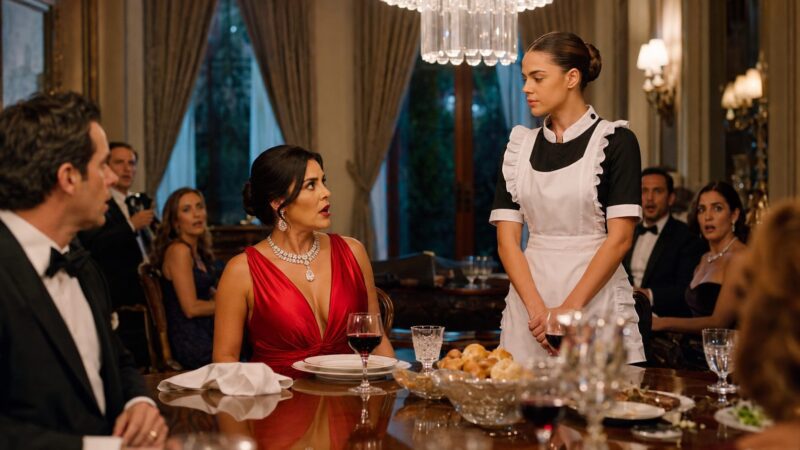
When Isabella dropped her silk napkin at the housekeeper’s feet and ordered her to kneel, she had no idea the woman in the apron owned the mansion, the hospital, and the future of her fiancé’s career. 😳
The dinner at the Lenoir mansion was supposed to be the kind of evening people photographed discreetly and talked about for years. Crystal chandeliers burned like frozen stars above the marble hall, soft piano music drifted through the room, and the long banquet table glittered with silver forks, red wine, white roses, and plates so delicate they looked more expensive than most people’s monthly rent.
Every guest had arrived dressed to be noticed, but Isabella Voss wanted to be remembered.
She sat near the center of the table in a deep red satin gown, diamonds shining at her throat, her blonde hair pinned perfectly behind her head. Beside her sat Dr. Rafael Costa, a celebrated surgeon whose smile had been carefully trained for wealthy donors, hospital boards, and rooms where powerful people decided other people’s futures.
Isabella had not been born into this world, and perhaps that was why she performed superiority so loudly. She laughed a little too sharply, corrected waiters a little too often, and spoke about “standards” as if kindness were something people with money could afford to ignore.
Moving quietly between the guests was Maya Lenoir, a woman in a black-and-white housekeeper’s uniform, with her dark hair tied neatly and her posture calm enough to look almost royal. No one paid much attention to her, which suited her perfectly, because Maya had not dressed that way to serve dinner.
She had dressed that way to see the truth.
For months, her family’s medical foundation had been considering Rafael for a leadership position, and Maya wanted to know what kind of man he became when there was no camera, no award, and no audience he considered important.
When Maya approached the main table with a bottle of rare red wine, Isabella lifted her glass without even looking at her.
“Careful,” Isabella said loudly, smiling at Rafael. “That wine costs more than your salary.”
The piano notes seemed to soften. A few guests looked down at their plates, pretending they had not heard, while Rafael gave a small amused smile and adjusted his bow tie.
Maya poured the wine without spilling a drop. Her hand remained steady, her eyes calm, and when the glass was filled perfectly, she lifted the bottle with quiet precision.
Isabella noticed the silence and enjoyed it. She had mistaken discomfort for power.
Then she let her silk napkin fall deliberately from her lap onto the marble floor.
“Pick it up,” she said, leaning back in her chair. “And try to remember where you stand.”
This time, nobody pretended not to hear. A young waiter froze near the wall, one of the older guests slowly lowered his fork, and Rafael’s smile stayed on his face just long enough to reveal the truth about him.
Maya looked at the napkin. For one brief moment, her expression changed, not with anger, but with memory. Years earlier, before the Lenoir name had meant hospitals and foundations, her mother had cleaned houses for women who believed uniforms erased dignity.
Maya had never forgotten that.
She placed the wine bottle on the table, removed her white gloves, and folded them carefully beside Isabella’s glass.
“You are making a dangerous mistake,” Maya said softly, “about who matters in this house.”
Isabella blinked, then laughed in a bright, cruel way that made the room feel colder.
“And who do you think you are?” she asked. “Some servant with a dramatic speech?”
Rafael shifted in his chair, still silent, still calculating whether the situation was worth interrupting. His silence answered before he did.
Maya looked at him first, then back at Isabella.
“My name is Maya Lenoir,” she said calmly. “And this is my mansion.”
The room changed in a single breath.
Someone gasped. Rafael’s face drained of color so quickly that the guest beside him reached toward his glass, afraid he might drop it. Isabella’s lips parted, but for once, no polished insult came out.
PART 2
Maya continued, her voice quiet but carrying through the entire hall.
“This dinner was arranged by my foundation. This estate belongs to my family. And tomorrow morning, Dr. Costa’s leadership review comes across my desk.”
Rafael stood too fast, his chair scraping loudly against the marble.
“Maya Lenoir,” he whispered, as if the name had become a verdict. “You’re the chairwoman of the Lenoir Medical Foundation.”
Maya nodded once.
Isabella’s eyes filled with panic, and the confidence she had worn like jewelry began to crack.
“I didn’t know,” she said, her voice smaller now.
Maya looked at her with a sadness that hurt more than anger would have.
“That is exactly the problem, Isabella,” she replied. “You believed respect was only necessary when the person in front of you had a name you feared.”
The words settled over the table like a judgment no one could appeal.
Rafael tried to speak, but Maya gently raised one hand.
“Your surgical skill is impressive, Dr. Costa,” she said. “But leadership begins with how a person treats those who cannot benefit them.”
He lowered his eyes.
Maya then bent down, picked up the fallen napkin herself, and placed it neatly beside Isabella’s plate. The gesture was not obedience. It was a lesson, delivered with more grace than Isabella deserved.
The dinner did not end in shouting. There was no dramatic exit, no broken glass, no public revenge. The piano began again, softer this time, and the guests returned to their seats with the uncomfortable knowledge that they had witnessed something far more powerful than humiliation.
The next morning, Rafael’s promotion was declined, not because he had made one mistake, but because his silence had revealed the kind of leader he would become.
Weeks later, Isabella sent a handwritten apology to the mansion. Maya read it once, then placed it in a drawer, not as a trophy, but as a reminder that some people only discover humility after losing the audience they were trying to impress.
And under the same chandeliers where Isabella had tried to measure a woman by her uniform, everyone finally understood that true power had been standing quietly beside the table all along. ✨