“There’s no place here for poor people,” Lydia said—without knowing the woman she humiliated could stop the sale of the entire jewelry house. 😨💎
My name is Mara Moreau.
I paused at the entrance of the jewelry house to close my wet umbrella and smooth the sleeve of my old navy coat. My bag handle had been stitched back together by hand. The only ring on my finger was a silver one that had belonged to my grandmother. 💍
Inside, everything gleamed.
Crystal chandeliers spilled warm light over the marble floor. Glass cases shimmered with diamonds, sapphires, and gold, as if even the air inside the salon had been polished.
One of the saleswomen smiled at me at first.
Then she noticed my shoes.
The smile disappeared.
But that wasn’t the part that hurt most.
Lydia was standing in the center of the room.
My childhood friend.
Years ago, we used to sit in the back row of the bus, split one sandwich in half, and promise each other that if we ever became successful, we would never be ashamed of where we came from—or of the people who had been beside us before anyone else cared.
Now she stood there in a dark red dress, a brilliant blue necklace resting against her throat. Beside her was her fiancé, Evan, whose investment company was trying to buy Belvedere, the jewelry house hosting the event.
Lydia saw me first.
Her eyes moved slowly over my coat, my bag, my shoes.
“What are you doing here?” she asked loudly enough for nearby guests to hear. 😶
“I was invited,” I said calmly.
She gave a short laugh.
“This is a private event.”
“I know.”
She stepped closer.
“Mara, at least look around you. There’s no place here for poor people. If you were going to come, you could at least have shown a little style.”
A few guests pretended not to hear.
Others heard every word and looked away.
I didn’t answer.
Instead, I looked at the necklace around her neck. 👀
I recognized it immediately.
The Blue Star.
It belonged to Belvedere’s archive collection and was supposed to remain in the vault unless two approvals had been recorded: one from the vault custodian and one from an authorized member of the foundation board.
The tiny display tag beside it showed one approval.
The second was missing.
Before I could say anything, the salon manager approached.
“Ms. Moreau,” he said carefully, “the board is waiting for you.”
Evan’s face changed at once.
He recognized my last name.
Lydia didn’t.
“The board?” she repeated.
Evan stared at me.
“You’re Mara Moreau?”
“Yes.”
A heavy silence followed.
“You’re the trustee whose vote is required for the sale.”
The color drained from Lydia’s face.
I looked at him.
“I’m the person who wants to understand what, exactly, you’re trying to buy.” ⚖️
Inside the boardroom, Evan began his presentation.
The number on the screen was impressive.
The slides were polished.
Every page was filled with words like growth, efficiency, restructuring, and strategic renewal.
But I’ve learned that the truth is often hidden in the attachments.
So I read those too.
That was where the real plan appeared.
The workshop would be closed.
Twelve master artisans would have their contracts terminated.
Their names were listed under a heading that called them “replaceable resources.”
I touched the page with one finger.
“Is this how you describe people?”
Evan shifted in his chair.
“They’re financial categories.”
“But the savings from removing them are already included in your valuation,” I said. “And your proposal presents the workshop as if it barely matters.”
He didn’t answer directly.
I opened the foundation charter.
The sale could only move forward under three conditions: the workshop had to remain open, the artisans had to be paid for the use of their designs, and the rights connected to the archive pieces had to be fully disclosed.
None of those conditions were included in Evan’s offer.
“You can’t just stop the deal,” he said sharply.
“I’m not stopping it. I’m delaying it for forty-eight hours pending an independent review.”
Then I looked again at Lydia’s necklace.
This time I noticed the archive registration number.
I knew that number.
The Blue Star had been moved out of the vault three weeks earlier.
Without second authorization.
“Before we continue,” I said, “I want to know who approved that necklace being taken out of the vault.”
Lydia stopped smiling. 😳
The head of security was called in.
He brought the transfer ledger.
I opened to the final page.
My name was there.
So was my signature.
There was only one problem.
I had never seen that document in my life.
“That is not my signature.”
No one moved.
The atmosphere changed instantly. 📄
Security records showed that only two people had accessed the vault that day: the salon manager and one of Evan’s company consultants.
Evan admitted the consultant worked for him.
Lydia stayed silent for several long seconds.
Then, with trembling fingers, she unclasped the necklace.
“I took it,” she said. “Evan told me we’d return it after the event. I didn’t know they had used your signature.”
I looked at her.
Years ago, she had promised me that success would never change us.
Now I couldn’t tell whether she was more afraid of losing me or losing the life she had built.
I placed the necklace on the board table.
Then I laid the transfer ledger open beside it.
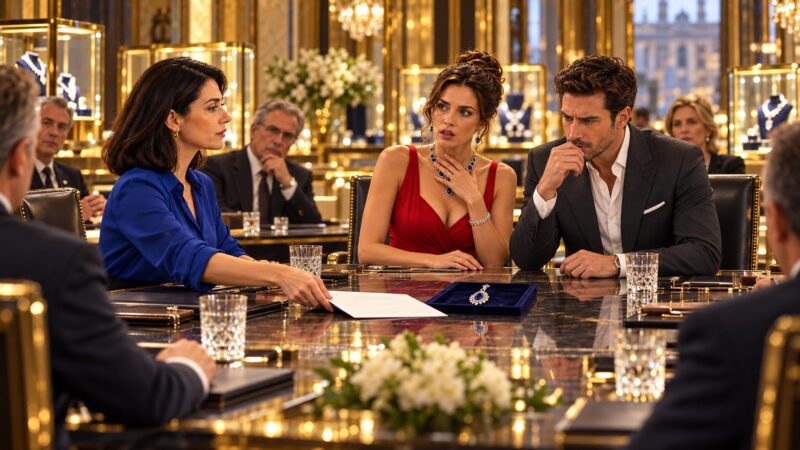
The independent review uncovered even more.
Evan’s valuation had omitted royalty obligations tied to the workshop’s original designs. It had also ignored several of the most profitable custom commissions from recent years.
The very people he had labeled “replaceable” were the reason Belvedere had value at all. 💎
I asked Nora, the workshop director, to join the meeting.
“If a buyer agrees to protect the workshop, recognize the artisans’ rights, and put every condition in writing,” I asked her, “would your team stay?”
Nora thought carefully.
“If we’re treated like professionals instead of cost lines,” she said, “yes.”
That answer became the foundation of a new agreement.
Evan’s company could accept those terms—or walk away.
No one was going to buy the house by stripping the people out of it.
After Lydia returned the necklace, she approached me.
Her voice no longer carried the confidence it had earlier.
“I’m sorry,” she said. “For what I said out there. For all of it.”
I looked at her.
“Are you apologizing because you hurt me,” I asked, “or because you found out my vote mattered?”
She lowered her eyes.
“Both,” she admitted. “And I know that makes it worse.”
I believed she was telling the truth in that moment.
But an apology doesn’t automatically restore trust.
Two months later, Belvedere reopened. ✨
The Blue Star was back in its case.
This time, a small plaque beside it listed the names of the artisans who had created it.
On reopening day, a little girl walked in with her mother.
The mother was still wearing her work uniform and looked uncomfortable the moment she stepped inside.
“Can we just look?” she asked softly.
Nora smiled.
“Of course. No one has to prove they belong here before they’re allowed to admire something beautiful.” ❤️
The little girl stepped closer to the glass, her eyes widening.
And watching her, I finally understood what had truly been at stake.
Not just a sale.
Not just a forged signature.
Not just a broken friendship.
What mattered was protecting the idea that beauty should never belong only to people rich enough to enter a room without feeling ashamed. 🌟