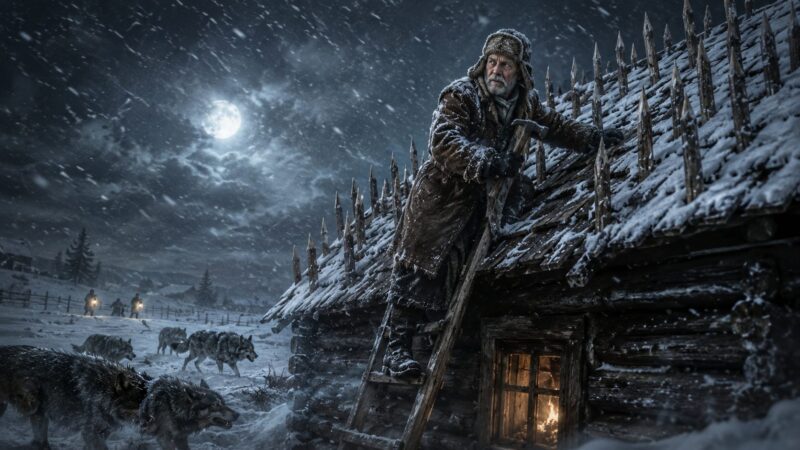
The villagers laughed when old Tomas began driving sharpened wooden stakes into his roof, but the laughter died the night winter climbed down from the mountains and something hungry came with it. ❄️
It began in the middle of summer, when the sun was bright enough to warm the old stones of the village and children still ran barefoot along the dusty paths. Tomas Arlen, a quiet seventy-six-year-old widower with trembling hands and a back bent from decades of work, dragged long pieces of wood into his yard and began carving their ends into sharp points.
At first, people assumed he was repairing the roof of his small cabin near the forest. Children gathered by the fence to watch him climb the ladder slowly, one painful step at a time, while he carried the stakes under one arm. His neighbor, Mira, called out that he should wait for help, but Tomas only gave her a tired smile and said the weather would not wait for anyone.
By the end of July, twenty stakes stood along the lower edge of his roof like jagged teeth against the blue sky. By August, there were more along the sides. By September, they covered the ridge, the eaves, and the narrow section above his bedroom window.
That was when the whispering began.
“He has lost his mind,” said Bruno, the baker, not with cruelty, but with the confused sadness people use when someone familiar becomes strange.
“He barely speaks anymore,” said Elina, who delivered milk to the far houses. “Since Sofia died, he has not been the same.”
Tomas heard them. He heard the jokes near the market, the low voices beside the well, and the boys pretending to hammer invisible stakes into their own roofs while laughing. He never shouted back, and he never explained himself. He only kept working, even when his knees shook so badly that he had to sit on the ladder and close his eyes before climbing higher.
Every evening, he sat alone on the roof until the light faded, rubbing his aching wrists and staring toward the black line of trees beyond the village. Sometimes he held a small red scarf in his hands, the one Sofia used to wear on winter walks. When the wind passed through the forest, he pressed the scarf against his chest as if it were the last warm thing left in the world. 🕯️
Years earlier, Tomas had tried to warn them once. He had stood in the square with shaking hands and told the villagers that something had climbed near his house during a hard winter, something strong enough to leave deep marks high on the wall. But grief had made his voice break so badly that people thought sorrow was turning memory into fear.
After that, he stopped asking anyone to believe him.
By autumn, his body began to fail. His fingers locked in the cold mornings, and twice Mira saw him slip and cling to the roof edge, gasping like a man who had nearly fallen into another life. She begged him to stop.
“Tomas, please,” she said one afternoon, standing below with a basket of bread in her arms. “Whatever this is, it can wait.”
He looked down at her, pale and sweating, and for a moment she thought he might finally tell her the truth. Instead, he glanced toward the forest and whispered, “No, child. It cannot.”
The first snow came early.
It arrived without warning, covering the fields in silence and turning every roof white before morning. The village became beautiful in the way dangerous things can be beautiful, with smoke rising from chimneys, frozen paths shining under moonlight, and the forest standing black and still beyond the last houses.
For two nights, nothing happened.
On the third night, the goats vanished from the old shed near the trees.
No blood was found, only broken boards, deep scratches in the frozen mud, and strange tracks half-buried beneath falling snow. The men followed them to the forest edge, but the storm erased everything before they could understand what they were seeing.
That evening, no one laughed about Tomas.
PART 2
By midnight, the wind was screaming between the houses, and the village dogs began barking all at once. Then, one by one, their barking faded into a silence that felt worse than noise.
Mira woke to a heavy scraping sound moving slowly over wood, followed by the crack of something climbing where nothing should climb. She ran to her window and saw lanterns appearing across the village as others woke too.
At the far edge of the settlement, Tomas’s cabin stood beneath the storm, its strange roof bristling with sharpened stakes. The snow had piled high against the back wall, creating a frozen ramp that almost reached the lower roof.
And in the moving darkness below it, something circled.
The villagers gathered at a distance, holding lanterns that shook in their hands. Through the snow, they saw Tomas standing inside his upstairs window, his face pale behind the glass, one hand pressed against the frame.
Then the roof shook.
A huge animal lunged from the snowdrift, trying to reach the window from above, but it struck the line of stakes and dropped back with a furious cry. Another shape moved along the opposite side, then another, their bodies thin from hunger and powerful enough to tear through sheds. They were wolves, driven down from the frozen heights and desperate enough to climb toward the warmth of human homes.
The villagers understood at once. The stakes were not madness. They were a wall.
No one knew where to look, because every person standing there remembered laughing at those stakes, and every laugh now felt like a stone dropped into their own chest.
Years before, Sofia had gone outside to bring in firewood during a storm like this and had never returned. Tomas had found only her red scarf near the trees and claw marks along the side of the house, too high for any ordinary dog. People had told him grief had confused him, but he had never forgotten what the snow tried to hide.
That night, the wolves tried again and again, but every path upward ended in sharpened wood. The cabin groaned, the stakes bent, and Tomas stood inside with his hammer in his hand, shaking from age and terror, yet still alive.
By morning, the storm weakened, and the pack disappeared back into the forest.
When the villagers finally approached, they found Tomas sitting beneath the window, exhausted, wrapped in Sofia’s red scarf. He looked smaller than ever, but his roof still stood above him like a crown of wooden thorns.
Mira knelt beside him with tears in her eyes and whispered, “We should have believed you.”
Tomas looked past her at the silent forest, then at the village roofs around him, bare and unprotected beneath the snow. His voice was weak, but every person heard it.
“Then start cutting wood,” he said. “Winter has only begun.” 😨