😱 The Girl Who Was Afraid to Go Home
“Please… don’t let him take me!”
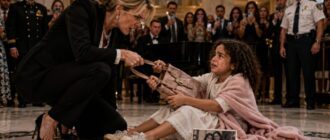
Emily’s fingers twisted into the front of Claire Bennett’s jacket so tightly that her knuckles turned white. The eight-year-old girl was barefoot, trembling beneath a thin, dirty dress, and breathing as though she had been running for her life rather than simply down a quiet winter street. Behind her, the bakery door slammed open, and a broad-shouldered man stepped onto the pavement with a wooden rolling pin hanging beside his leg. He did not call Emily’s name with relief. He looked at her with the cold fury of someone watching his property escape.
Claire had noticed the girl only moments earlier while walking back from lunch. Emily had burst from the bakery into the freezing afternoon, nearly slipping on the wet pavement as she ran. Her feet were red from the cold, her face was hollow with hunger, and she kept looking behind her as though every second mattered.
Claire was not wearing a uniform, but four years of police work had taught her to recognize fear that could not be rehearsed. Children might lie with words when adults pressured them, yet their bodies often told the truth first. Emily did not merely look frightened of the man approaching them; she folded inward at the sight of him, hiding her face against Claire’s side while her entire body shook.
The man stopped several feet away and forced a smile that did not reach his eyes.
“There you are,” he said, breathing heavily. “She’s my niece. She steals food, runs away, and causes trouble whenever she doesn’t get what she wants.”
Emily flinched at the sound of his voice.
Claire gently moved the girl behind her. “What’s her full name?”
The man blinked. “Emily Hale.”
Emily’s grip tightened.
“And her birthday?”
“In March.”
Claire waited.
“The twelfth,” he added quickly.
From behind Claire came a whisper so faint she almost missed it.
“October.”
The man’s expression hardened. “She gets confused. Her mother filled her head with nonsense before she disappeared.”
Claire kept her voice calm, although a warning had begun to pulse beneath her ribs. “What school does she attend?”
“She doesn’t. We teach her at home.”
“Where do you live?”
“Above the bakery.”
Claire glanced at the dark upper windows. “What’s your relationship to her mother?”
“My sister.”
“What’s her name?”
For the first time, the man hesitated too long.
“Anna.”
Emily shook her head against Claire’s back.
The man took a step forward. “This is ridiculous. She belongs with me.”
Claire’s gaze sharpened. “Children belong with people who make them feel safe, not people who make them stop breathing.”
The words landed heavily between them.
His smile vanished. “You don’t understand what you’re interfering with.”
Claire reached slowly inside her jacket and opened her badge wallet, angling it directly toward him.
“Police,” she said. “Step away from the child.”
His eyes moved from the badge to the street behind Claire, calculating distance. Then he looked back at Emily, and the rage in his face made her bury herself deeper against Claire.
Claire pressed the emergency button on the radio concealed beneath her jacket. “Emily,” she said quietly, never taking her eyes off the man, “is there anyone else inside that bakery?”
The child’s breathing became uneven.
The man interrupted. “Don’t listen to her. She invents stories.”
Claire raised one hand. “I wasn’t speaking to you.”
Emily swallowed hard. “There’s a boy in the storage room.”
The man’s face changed.
PART 2
It was subtle, no more than a flicker, but Claire saw it.
“He’s younger than me,” Emily continued, her voice shaking. “Victor locks the door when customers leave. He says nobody will believe us because we took food.”
Victor turned toward the bakery.
Claire moved at the same moment. “Don’t.”
He ran.
The rolling pin struck the pavement as he dropped it and reached the bakery entrance, but two uniformed officers were already turning onto the street in response to Claire’s silent alert. Victor tried to pull the door shut behind him, only to be intercepted before he could lock it.
Inside the bakery, the warm smell of bread hid something far darker. Officers found a cramped storage room with a mattress, two blankets, children’s clothing, and a ten-year-old boy named Mateo, who had been reported missing six weeks earlier. A small notebook beneath the counter contained names, dates, and amounts of money Victor had earned by forcing the children to clean, carry deliveries, and steal from nearby shops.
Emily’s real identity was confirmed that evening through a missing-person report filed eighteen months earlier. She had become separated from her mother during a crowded train evacuation after an electrical fire. Victor had found her alone at the station and promised to take her to the police, but instead brought her to the bakery, changed her surname, and convinced her that her mother had stopped searching.
Her mother, Sofia Laurent, had never stopped.
When Claire called her, Sofia could not speak for several seconds. She only made a broken sound that seemed to contain eighteen months of grief, guilt, and hope. The reunion took place the following morning in a child-protection center, where Emily stood frozen until Sofia quietly sang the lullaby she had used when Emily was small.
Then Emily ran.
This time, she was not running away.
Victor was charged with kidnapping, unlawful confinement, child exploitation, assault, and obstruction of justice. The notebook, surveillance footage, witness statements, and evidence from the locked room left him little room to deny what he had done. Mateo was reunited with his family, while both children received medical care and long-term counseling.
Weeks later, Claire visited Emily and Sofia at a small café near the river. Emily sat beside the window wearing warm shoes and a yellow coat, slowly eating a buttered roll. Halfway through, she looked around as though expecting someone to take it from her.
Sofia placed another roll on her plate.
“You don’t have to hurry,” she said. “There will always be more.”
Emily took a careful bite, then smiled for the first time Claire had ever seen. 🥹
Claire understood then that courage was not always loud, and rescue did not always begin with sirens. Sometimes it began with a frightened child holding on to a stranger and hoping, against everything she had learned, that one adult might finally listen.