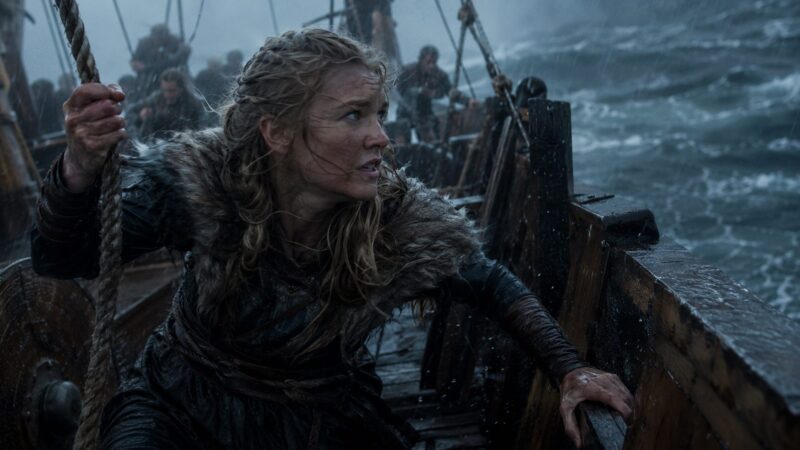
🌊 SHE SHOULDN’T HAVE SURVIVED. THE SEA HAD OTHER PLANS. ⚔️
The wave hit at midnight. 🌑
They said no woman should stand at the bow of a longship. They said the gods would punish any crew foolish enough to let one lead. Freydís Eiríksdóttir had heard it all before — and she had also watched every man who said it quietly step aside when she gripped her axe. 🪓
She was 28 years old. She was a queen. And in the year 1000 AD, somewhere in the black mouth of the North Atlantic, she was about to disappear into the ocean. 🌊
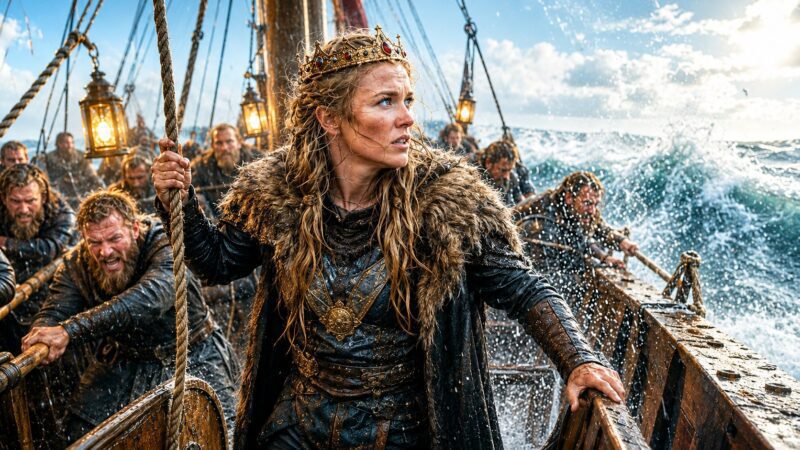
The storm had been building for three days. ⛈️
The Serpent’s Tooth — a 72-foot oak longship carrying 32 warriors and trade goods bound for Vinland — had already lost one sail. Two men had been swept from their benches when the first squall hit. Freydís had ordered the rowers to chain their wrists to the oars. Not to keep them rowing. To keep them alive. 💪
Her navigator, a one-eyed Icelander named Bjørn Halfhand, had told her the storm would break by dawn. He was wrong. The storm didn’t break — it doubled. ❌
By the fourth hour of darkness, the sea had stopped looking like water. It looked like a living thing. Mountains of black water, each one taller than the ship’s mast, rising and collapsing with a sound like the earth splitting open. The crew — hardened men who had raided the coasts of Britain, Ireland, and Francia — were praying. Some were crying. 😰
Freydís was not crying.
She was at the bow, one hand gripping a rope, the other locked on the rail, watching the water. Her crown — gold, inlaid with garnets, taken from a Frankish bishop who had begged for his life — was still on her head. She had refused to take it off. A queen does not undress for a storm. 👑
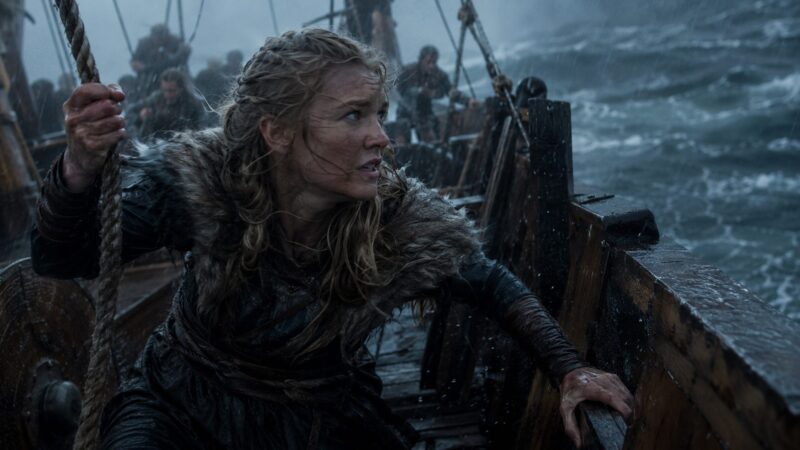
What happened next is recorded — barely — in two fragmented Icelandic sagas. 📜
The first wave struck the port side and staggered the ship sideways. Men tumbled. A barrel of salted fish shattered across the deck. Freydís turned and screamed an order — one word, in Old Norse — that the sagas translate only as “HOLD.” 🗣️
The second wave was different. It didn’t hit the ship. It absorbed it.
The Serpent’s Tooth went vertical. The bow — and Freydís with it — punched straight into the black water at a near-vertical angle. The ship shuddered, groaned, and then did something no one expected: it came back up. 😱
But Freydís was gone.
The crew assumed she was dead. Bjørn Halfhand, already mourning, was preparing to assume command — when something broke the surface thirty feet off the starboard side. A hand. Then a shoulder. Then a crown, water pouring off it in sheets. 💎
Freydís Eiríksdóttir had been dragged under by a 40-foot wave, swept beneath the hull of a fully loaded longship in a North Atlantic storm, and surfaced.
Still wearing the crown. 👑🌊
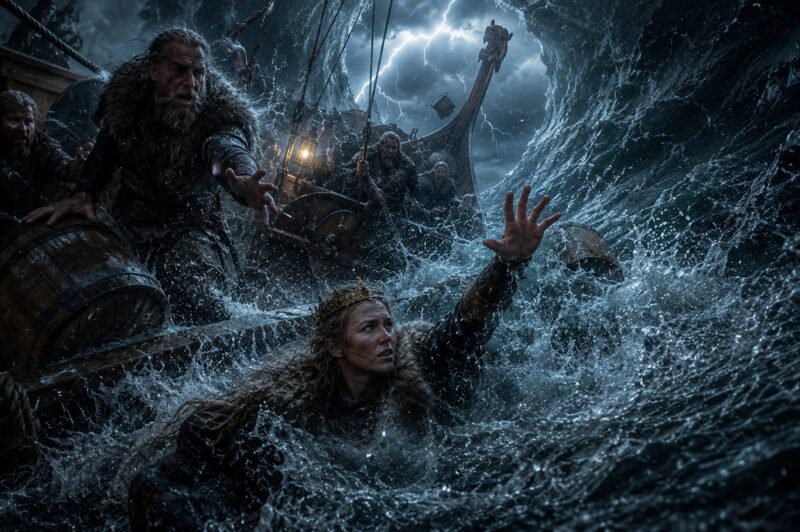
They pulled her back aboard with a rope. She was hypothermic, bleeding from a gash across her temple, and had lost two fingers on her left hand — crushed against the hull during the plunge. 🩸
She didn’t ask for a blanket. She didn’t ask for mead. She walked — unassisted — back to the bow. She retook her position. She gripped the rope with one hand and the rail with the other. And she watched the storm until it broke. 💪⚡
Three hours later, the sky cracked open with the first grey light of dawn. The sea smoothed. The crew sat in silence. ☀️
According to the saga, not a single man ever questioned her leadership again. 🛡️
Historians debate whether Freydís was truly a Norse queen, a composite figure, or historical myth. What they do not debate is this: the sagas describe real women commanding real ships. The archaeological record of the Viking Age is full of women buried with weapons, navigation tools, and the remains of the sea. 🏺⚔️🧭
These women existed. They sailed. They led. They survived things that should have killed them. 💫
And sometimes — just sometimes — they came back up still wearing the crown. 👑
History doesn’t always remember the women who held the ship together. But the sea does. 🌊