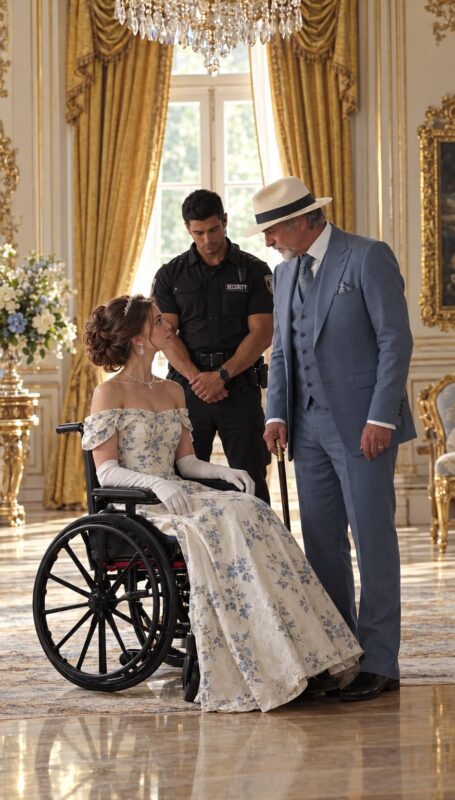
Her father wanted her married before she could walk again—but one tiny movement exposed everything. 😨
For eight months, Olivia had lived in a wheelchair.
A terrible car accident had left her with a serious spinal injury, and although doctors had never said she would remain disabled forever, her father, Richard, had already decided that her old life was over.
He treated her like a burden.
One evening, while Olivia sat alone in the enormous family living room, Richard walked in and delivered the news that would change everything.
“You can’t keep living like this,” he said.
Olivia looked up from her wheelchair.
“Like what?”
“Depending on everyone.”
“I never asked you to take care of me.”
Richard ignored her.
Then he looked toward the young man standing near the doorway.
His name was Michael, the family’s driver.
“You’re getting married.”
Michael froze.
Olivia stared at her father.
“What?”
“You heard me.”
Richard continued as if he were discussing a business deal.
“Michael will have a house, a better salary, and a secure position. You’ll have someone to look after you.”
Olivia let out a bitter laugh.
“So you’re handing me over to your driver?”
“I’m securing your future.”
“No, Dad. You’re getting rid of me.”
Richard’s expression hardened.
Michael finally stepped forward.
“She doesn’t need a husband to take care of her.”
Richard slowly turned toward him.
“You seem to have forgotten who signs your paycheck.”
“And you seem to have forgotten she’s your daughter.”
Silence filled the room.
For the first time in months, Olivia felt someone was actually seeing her—not her wheelchair, not her injury, but her.
That night, Michael helped her leave the room.
Not because Richard ordered him to.
Because he couldn’t stand watching her being treated like property.
He helped Olivia onto a sofa and stepped back.
Then she suddenly squeezed his hand.
Michael stopped.
“Olivia?”
He looked down.
Her right index finger had moved.
Barely.
But it had moved.
“You just moved your finger.”
Olivia stared at her hand.
“I… I couldn’t.”
“I felt it.”
Then they heard footsteps.
Richard stood in the doorway.
Michael turned toward him.
“Your daughter can move her fingers.”
Richard went completely still.
But instead of smiling, he looked terrified.
Olivia noticed.
“Dad?”
Richard quickly recovered.
“It’s probably just a nerve response.”
She narrowed her eyes.
“How did you know?”
He didn’t answer.
And that silence stayed with Olivia all night.
The next morning, Michael secretly took her to an independent neurologist.
The results were shocking.
There were still active signals traveling through Olivia’s nervous system.
Her recovery wasn’t guaranteed.
But she wasn’t hopeless.
The doctor looked directly at her.
“With intensive rehabilitation, you may regain significant movement.”
Olivia’s eyes filled with tears.
“But my father told me the doctors said I would never recover.”
The doctor frowned.
“I don’t see that anywhere in your records.”
Olivia felt the room suddenly become cold.
With Michael’s help, she obtained copies of her previous medical reports.
The truth was worse than she imagined.
Several doctors had recommended continued rehabilitation.
Richard had received every report.
He had simply never shown them to her.
Then they found something else.
Before Olivia’s mother died, she had placed a condition in her will.
When Olivia reached a certain age, she would gain control of a major portion of the family company.
Unless she was officially declared permanently incapable of managing her affairs.
In that case, control of her assets would temporarily remain with Richard.
Olivia stared at the document.
Her voice trembled.
“He needed me to stay dependent on him.”
Michael shook his head.
“We don’t know if he caused the accident.”
Olivia looked at him.
“But we know he hid my chances of recovery.”
That was enough.
That evening, Olivia confronted her father.
“You knew.”
Richard said nothing.
“You knew I could improve.”
Still nothing.
Finally, he whispered:
“I was protecting what I built.”
Olivia’s eyes filled with tears.
“Was I part of what you built?”
Richard looked away.
“You’re my daughter.”
“No,” Olivia said quietly. “I was your daughter until you decided my disability gave you the right to control my life.”
She turned her wheelchair toward the door.
And this time, Richard couldn’t stop her.
The months that followed were brutal.
Olivia began intensive rehabilitation.
Some days she made progress.
Other days she spent hours trying to move a muscle that refused to respond.
There were moments when she wanted to quit.
Michael never promised that she would walk again.
He simply stayed.
“Try once more,” he would tell her.
“And if it doesn’t work?”
“Then we try again tomorrow.”
One morning, after months of therapy, Olivia gripped the support bars.
Her legs trembled.
She pushed herself upward.
For three seconds, she stood.
Then she collapsed back into her chair.
Tears streamed down her face.
“I stood.”
Michael smiled.
“Yes, you did.”
“I’m scared.”
“Being scared doesn’t mean you’re weak.”
A year later, Olivia took control of the shares that legally belonged to her.
Richard lost his position at the company.
He was never imprisoned because there was no evidence that he had caused the accident or physically harmed Olivia.
But he was forced to answer for hiding crucial medical information and exploiting his daughter’s dependence to maintain control over her life and finances.
Michael eventually left his job as the family driver.
Olivia offered him a position at the rehabilitation center she founded.
He looked at her in disbelief.
“Why me?”
She smiled.
“Because you were the first person who didn’t try to save me.”
Michael laughed softly.
“I think you saved yourself.”
Two years later, they married.
Not because of a contract.
Not because Richard arranged it.
Not because money was involved.
They married because, for the first time, the decision belonged entirely to them. ❤️
Olivia still used a wheelchair on difficult days.
On better days, she walked with crutches.
She never apologized for either.
At the entrance of her rehabilitation center, she placed a small sign:
“Needing help does not make you weak. Taking away someone’s choice does.”
And whenever people asked what changed her life, Olivia never mentioned the day she first stood.
She always remembered something much smaller.
A finger.
One tiny movement that her father was terrified to see.
Because that movement proved something he had spent months trying to hide.
Olivia still had a chance.
And, more importantly, her life still belonged to her. ❤️