
“Call security. He doesn’t belong here.” 😨
The woman behind the glass said it loudly enough for half the bank to hear.
A few employees laughed.
The older man standing at the counter did not.
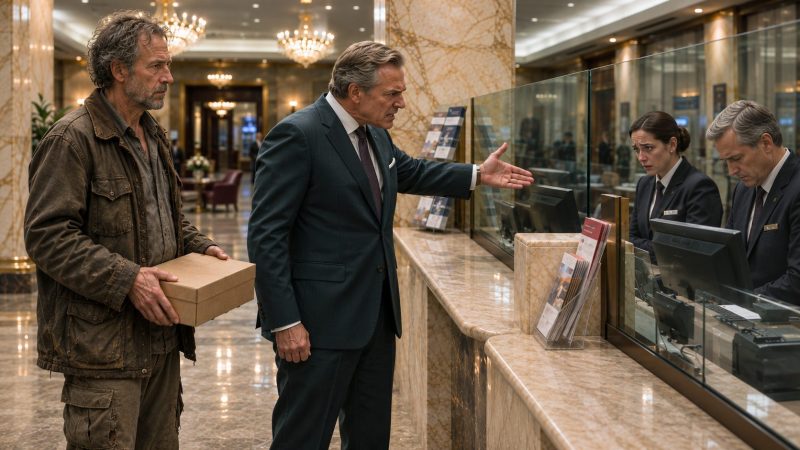
He wore a faded brown jacket, worn cargo pants, and scuffed boots. His gray hair was messy, his beard looked as though it had not been trimmed in weeks, and he held an old cardboard box carefully against his chest.
Everything around him looked expensive.
Polished marble floors.
Crystal chandeliers.
Glass counters.
Perfect suits.
The man looked down at his clothes, then back at the teller.
“I only asked how to open a small-business account.”
Laura barely looked away from her computer.
“And I told you that you need proper documents.”
“I have them.”
“Business registration?”
“Yes.”
“Identification?”
“Yes.”
“Opening deposit?”
“Yes.”
Laura finally looked directly at him.
Her eyes moved from his dirty boots to the battered cardboard box.
At the next counter, Nina leaned toward her and whispered something.
Both women laughed.
The man heard them.
“What was funny?”
Laura leaned back in her chair.
“Nothing.”
Then she smiled.
“It’s just that people usually dress a little more appropriately when they come here to discuss business.”
The man remained calm.
“What does a serious customer look like?”
Neither woman answered.
Nina glanced toward the entrance.
“Maybe we should call security.”
Laura gave a short laugh.
“He’s already making people uncomfortable.”
The man looked around.
No customer had complained.
No line had been blocked.
He had not raised his voice.
He placed the cardboard box gently on the marble counter.
“Am I making people uncomfortable because of something I did?”
Laura’s smile faded slightly.
“Sir, please don’t make this difficult.”
“I’m asking a question.”
Nina reached toward the phone.
“If you refuse to leave, we’ll have security escort you out.”
That was when Ethan, the branch manager, heard her.
He had just walked out of a meeting room at the far end of the hall.
At first, he only saw an older man in worn clothing standing at the counter.
Then he noticed the cardboard box.
The faded brown tape around it.
And the watch on the man’s wrist.
Ethan stopped.
He had seen that watch less than a week earlier at a private board meeting.
His face changed immediately.
He walked toward the counter.
“What is going on here?”
Laura straightened in her chair.
“This gentleman wants to open a business account, but he doesn’t seem to have—”
“I do have documents,” the man interrupted calmly.
Laura froze.
“I simply haven’t been asked to show them.”
Ethan looked from Laura to Nina.
“Were you about to call security?”
Neither answered.
Ethan’s voice hardened.
“Did he threaten anyone?”
“No.”
“Did he cause a disturbance?”
“No.”
“Did he refuse to provide identification?”
Laura swallowed.
“We hadn’t gotten that far.”
Ethan stared at her.
“So you were going to remove a customer before even finding out why he came here?”
Laura’s face reddened.
“We were just trying to protect the atmosphere of the branch.”
“The atmosphere?”
Ethan looked genuinely furious now.
“You laughed at him, judged his clothes, and were preparing to call security because he didn’t look wealthy enough for you.”
Nina lowered her eyes.
The older man said nothing.
Ethan turned toward him.
“Mr. Hale, I am deeply sorry.”
Laura looked up sharply.
Nina’s hand froze beside the phone.
“Mr… Hale?” Laura whispered.
The man slowly turned toward Ethan.
“My name isn’t important yet.”
But it was already too late.
The employees knew the name.
Aram Hale was the investor whose capital was funding the bank’s new small-business program.
He was expected at headquarters later that week to sign the final agreement.
Laura’s face went pale.
“You’re… Aram Hale?”
Aram looked at her.
“If I weren’t, would anything that happened here suddenly become acceptable?”
No one answered.
Laura stood up.
“Mr. Hale, I sincerely apologize.”
Aram looked at her for several seconds.
“If I had no money, would you still apologize?”
She could not answer.
Aram opened the cardboard box.
There were no stacks of cash inside.
No expensive documents.
Instead, there were old accounting ledgers, faded invoices, handwritten orders, and a small metal sign.
The letters were scratched and worn:
HALE REPAIR — EST. 1994
Aram lifted the sign.
“This belonged to my father’s workshop.”
He ran his thumb across the faded lettering.
“When I was nineteen, I walked into a bank dressed almost exactly like this.”
The room became completely silent.
“I needed a loan for two machines. The manager looked at my clothes and told me businesses like mine weren’t worth the bank’s time.”
Nina looked at the old ledgers.
“What happened?”
“Another bank listened.”
Aram placed the sign back into the box.
“That tiny workshop eventually employed hundreds of people.”
Laura looked ashamed.
Aram shook his head.
“But I didn’t come here today to prove how successful I became.”
He looked around the branch.
“I came to find out what happens to someone who looks unsuccessful.”
Ethan took a slow breath.
“This should never have happened. I’m responsible for this branch.”
“You are,” Aram said. “But firing two people won’t fix a culture.”
Laura looked up, surprised.
“You’re not firing us?”
“That isn’t my decision.”
Aram paused.
“And humiliation should not be answered with more humiliation.”
Just then Nina glanced at her computer.
Her expression changed.
“Mr. Ethan…”
“What?”
“There’s something you need to see.”
She opened the previous day’s rejection log.
“The same customer appears three times as ‘missing required documents.’”
Ethan frowned.
“So?”
Nina swallowed.
“I remember him.”
She looked increasingly uncomfortable.
“We never checked his documents.”
Aram’s eyes narrowed.
“Then why does the system say you did?”
Laura stared down at the desk.
Ethan turned toward her.
“Laura?”
She hesitated.
Then finally spoke.
“The old branch supervisor started it.”
“Started what?”
“If customers looked like they would open very small accounts or take too much time, we sometimes marked them as incomplete before a full consultation.”
Ethan stared at her.
“Why?”
“Our service-time scores.”
The answer hung in the air.
“The faster we moved people through the branch, the better our performance numbers looked.”
Aram slowly closed the cardboard box.
“So people who appeared less profitable were pushed out before anyone even listened to them.”
No one argued.
That was the real reason he had come.
Not to catch one rude employee.
To find out whether one ugly moment was an accident…
or a system.
An independent review began that week.
Rejected applications were reopened.
Customers who had been turned away without proper review were contacted personally.
Performance targets that rewarded employees for getting rid of “low-value” customers quickly were removed.
The staff went through new customer-service training.
Aram did not cancel his investment.
But he added one condition.
The new small-business program would not be measured only by how much money it earned.
It would also measure how many people were actually heard. ❤️🩹
A few days later, an elderly woman entered the bank carrying an old handbag and a folder of wrinkled papers.
She approached Laura’s counter nervously.
“I’m not sure if this is the right place.”
Laura looked at her worn coat.
Then she glanced toward the old cardboard box Aram had deliberately left on a shelf behind the counter.
For a moment, she remembered the laughter.
The phone in Nina’s hand.
The security guard they had almost called.
Then Laura smiled.
“Let’s find out together.”
The woman smiled back. ❤️
And from that day on, the old cardboard box stayed in the branch.
Not because there was anything valuable inside it.
But because it reminded everyone of something far more valuable:
You can never know a person’s worth by deciding what they deserve before you even hear their story.