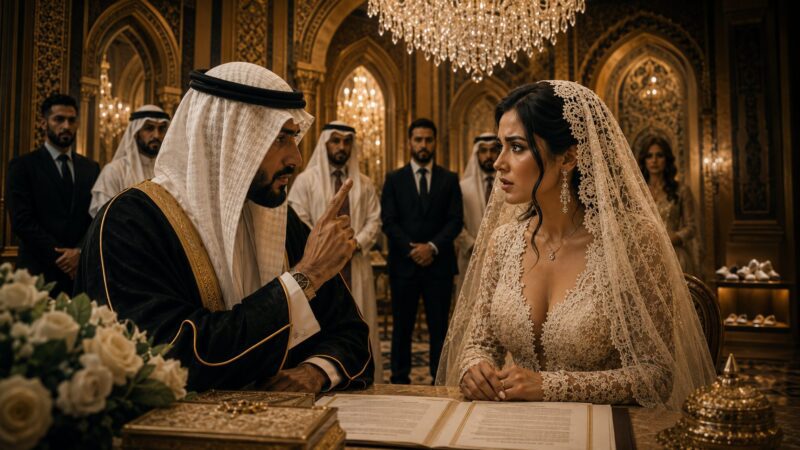
At the wedding table, while the ink on the marriage contract was still wet, Sheikh Omar leaned toward his bride and said, “You must have a child every year until our eldest turns eighteen. This condition cannot be broken.”
Elena’s fingers froze around the pen. Across the golden hall, guests pretended not to hear, but Omar’s younger brother, Rami, smiled as if he had been waiting for that sentence all evening. 😨
Elena looked at the Sheikh’s calm face, then at the contract in front of her. She was twenty-three, dressed in silk and pearls, and already her marriage felt like a door closing behind her.
“I agree,” she whispered.
In the first year, she gave birth to a son, Adam. Omar stood beside her hospital bed with tears in his eyes, holding the baby as if he were afraid the child might break. That surprised Elena. He was not cruel in private. He sent doctors before she asked, sat outside the nursery whenever Adam had a fever, and once, when Elena woke from a nightmare, she found him asleep in a chair beside the crib.
But every month, a sealed envelope arrived from the old family court, signed by Judge Kareem. Omar opened each one alone.
Sometimes he returned late from village hospitals with dust on his shoes and children’s drawings folded carefully in his pocket. When Elena asked where he had been, he only said, “Family business,” and kissed Adam’s forehead with a sadness she did not understand.
In the second year, their daughter Leila was born too early. Elena nearly died before sunrise. She remembered white lights, a doctor shouting for more blood, and Omar’s hand gripping hers so tightly his ring left a mark on her skin.
When she woke, he was sitting beside her, unshaven and pale.
“No more,” she said weakly.
Omar lowered his eyes. “Rest now.”
It was not an answer.
After Leila came home, the palace changed. Rami visited more often. He walked through the nursery with soft steps and sharp eyes, asking innocent questions that never felt innocent.
“Two children in two years,” he told Elena one afternoon, smiling over his coffee. “My brother is a man of tradition.”
Elena looked at Omar, expecting him to correct him. Omar said nothing.
That silence hurt more than the words. 💔
By the third year, Elena was afraid of her own calendar. She stopped opening invitations, stopped passing the nursery wing at night, and folded away Leila’s tiny clothes with trembling hands. When the palace doctor examined her, his face became serious before he even spoke.
A third pregnancy could kill her.
PART 2
Elena waited for Omar to argue, to command, to remind her of the wedding condition.
Instead, he stood completely still, as if the sentence had struck him harder than it had struck her.
That night, Elena found a brass key hidden inside Omar’s desk beneath a stack of court papers. She should have left it there, but fear had made her brave. The key opened a narrow room behind the old library, a room she had never seen before.
Inside were children’s shoes.
Not two pairs. Dozens.
Tiny sandals, winter boots, school shoes with broken buckles, all cleaned and arranged on shelves. On the wall hung photographs of children Elena did not recognize. Under each picture was a date and a name.
Year One: Adam.
Year Two: Leila.
Year Three: Pending.
Her stomach turned cold.
Then she noticed something stranger. Beside Adam and Leila’s names were not only birth certificates, but legal guardianship papers, trust documents, and letters from orphanages across the country. One letter carried the same silver palm tree symbol she had seen on Omar’s sealed envelopes.
Before she could read more, footsteps stopped behind her.
Omar stood in the doorway.
For the first time since she had known him, the Sheikh looked frightened.
“You lied to me,” Elena said.
His gaze dropped to the key in her hand. “Yes.”
“Are these your children?”
“Yes,” he said quietly. “But not the way you think.”
The words nearly broke her.
Omar stepped inside slowly and opened the oldest folder. It was his father’s will. The language was formal, cold, and cruel, but one line had been underlined.
Each year, until the eldest heir reaches eighteen, the ruling house must add one child under its lawful protection, whether by birth, adoption, or guardianship. If the condition is broken, control of the family trust passes to the second son.
Elena read it twice.
“The family trust?” she whispered.
“Hospitals, schools, orphan homes,” Omar said. “My father created the rule to control me. Rami wants the trust because he believes charity is weakening our family and wasting our fortune. If he takes it, he will close everything that does not make money.”
Elena looked at the shoes again. Suddenly they were not trophies. They were memories. 🕊️
“The condition was never only about me having babies,” she said.
“No,” Omar answered, voice rough. “But I let you believe it because Rami was watching us from the day we married. I needed witnesses to hear you accept the condition so he could never claim you were outside the guardianship line. If Rami had found proof that you knew the loophole before signing, he would have challenged everything.”
He swallowed.
“I thought I was protecting the children. I forgot to protect you from the fear.”
The next morning, Rami arrived with lawyers, expecting to find Elena broken and Omar cornered. Instead, he found them in the small palace courtroom beside a quiet three-year-old boy with burn scars on one hand. His name was Sami. His parents had died six weeks earlier, and the orphanage could not keep him safe.
Elena knelt before the boy. “Do you like stories?” she asked softly.
Sami nodded.
“Then tonight, you can sit with me, and I’ll read you one.”
Rami’s face changed. “This is fraud.”
Judge Kareem adjusted his glasses. “No. It is the exact wording of the will. A child under lawful protection.”
For the first time, Omar did not speak for Elena. He waited.
Elena signed the guardianship paper herself. ✍️
Years later, people still repeated the wedding story as if it were a tale about a cruel Sheikh and a trapped bride. They never knew the truth: every year, Elena and Omar welcomed one child into their protection, some newborn, some abandoned, some old enough to arrive with silence in their eyes.
When Adam turned eighteen, the palace garden was full of brothers and sisters. Omar placed the trust documents in his son’s hands, and Elena watched beside him, her black hair streaked with silver.
The strange condition had not built a prison after all.
It had built a family. ❤️