
Her son shoved her through a glass door—because she refused to sign. 😨
I did not even have time to reach for anything.
The glass cracked behind my back.
A second later, it shattered.
I crashed through the door and landed on the stone patio outside.
Pain shot through my arm.
Something warm ran down the side of my face.
When I touched my temple, there was blood on my fingers. 💔
Inside the house, my son Mark stood completely still.
He did not come toward me.
He did not ask whether I could breathe.
Only minutes earlier, he had been shouting.
“You can’t freeze everything.”
“The bank has to release that loan by Friday.”
I had been holding a folder against my chest.
“I never signed that loan.”
His face changed.
Mark stepped forward.
He ripped the folder from my hands.
Then he shoved me hard with both hands.
Now I was lying among broken glass.
And my own son was still staring at me.
That was when I understood this was no longer an ordinary family argument.
My phone was still in my pocket.
With a shaking hand, I called Simon.
He had been my late husband’s attorney.
“Simon… stop the transfer.”
“Mark pushed me.”
“The documents are fake.”
Simon asked only one question.
“Are you somewhere safe?”
I barely had time to answer.
A neighbor had seen the broken glass and already called for help.
A few hours later, I was in the hospital.
My arm was badly bruised.
The cut near my temple needed stitches.
But the worst pain was not physical.
Mark was my only son.
After my husband died, he was the one who convinced me to move into his home.
“I don’t want you living alone, Mom,” he had said.
At first, I believed him.
His wife, Nadia, brought me tea.
She reminded me to take my medication.
Then their questions slowly changed.
Where were the family trust documents?
How much money was in the trust?
Who had the authority to change its terms?
I never gave them those answers.
My husband had created that trust to protect me.
It was never meant to rescue Mark’s business.
A few days before the argument, I found a folder in Mark’s office.
Inside was a loan application.
Property owned by the family trust had been listed as collateral.
My name appeared on the final page.
So did my “signature.”
But I had never signed it. 📄😨
Underneath was another document.
It was a draft petition requesting legal guardianship over me.
It claimed I had started forgetting important things.
It said I could no longer manage my own finances.
And it named Nadia as the person who should make decisions for me.
I photographed every page.
Then I called Simon.
He did not freeze anything simply because I was frightened.
He first reviewed the trust agreement.
Then he contacted the independent trustee.
Only after that did he formally ask the bank to pause the loan until my signature could be verified.
That was what made Mark furious.
The next day, Simon came to my hospital room.
He carried another stack of documents.
“Alice, this started earlier than we thought.”
He placed the loan package beside me.
It had been prepared three weeks before Mark pushed me.
The guardianship papers had been drafted even earlier.
Then Simon showed me an email from the lender.
It said that if control of my finances were legally transferred to Nadia, the deal might proceed without my direct approval.
I read the sentence twice.
Friday was not just a deadline.
Friday was the final step of their plan. 😨
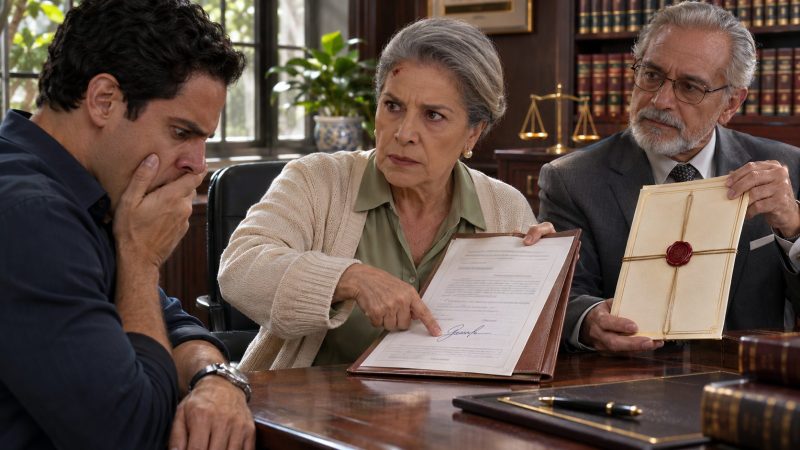
An independent examiner later confirmed the signature had been copied from an older document.
It had been transferred onto the new loan application.
Simon also uncovered messages between Nadia and a loan broker.
One message read:
“If the guardianship is approved, Alice’s separate consent should no longer be a problem.”
I stared at those words for a long time.
Mark later claimed he had never asked anyone to forge my signature.
That might have been true.
But he knew I had never approved the collateral.
He also knew his company was trying to survive using my trust.
Nadia eventually admitted that she had arranged the altered paperwork.
“The company was going to collapse,” she said.
“People would lose their jobs.”
I looked at her.
“So you decided my home and my rights were acceptable losses?”
She had no answer.
The bank stopped the loan.
The suspicious documents were sent for independent investigation.
The guardianship petition never moved forward.
Mark’s company had to sell equipment and restructure its debts.
There was no miracle solution.
Nobody was rescued overnight.
But my home and the trust my husband had created were no longer at risk. ⚖️
I moved into my own apartment.
For the first few weeks, Mark called repeatedly.
I did not answer.
Eventually, he stopped asking me to remove the bank restrictions.
One day, he simply sent a message.
“Can I come and talk?”
I allowed him to visit.
He came without documents.
Without a briefcase.
Without anything for me to sign.
He sat across from me.
“When I pushed you, all I could think about was the loan.”
His eyes filled with tears.
“Then I saw you on the other side of that broken glass.”
“And I realized what I had become.”
I did not forgive him immediately.
He did not ask me to.
A month later, Mark came back.
This time, he carried the bank’s final letter.
The loan was closed.
There was no longer any authorization connected to my name.
He placed the letter on the table.
“Can I start again?”
I looked at his hands.
They were the same hands that had shoved me.
Now they were trembling around a coffee cup.
“You can start again.”
I paused.
“But trust isn’t like a signature.”
“You cannot write it for someone else.”
Mark nodded.
That day, he asked me for no money.
No property.
No signature.
And for the first time in a long while, the decision truly belonged to me. ❤️🩹